What Grows in the Gaps of our Information Landscape
Our information landscape has much in common with the physical landscapes we create: there are popular, habitually crowded spots (social media, entertainment, news sites); serene, personal spaces (blogs, journals); and well-trodden paths all (excepting Robert Frost) take. There are also the dark spaces – some seek them out, others just get lost.
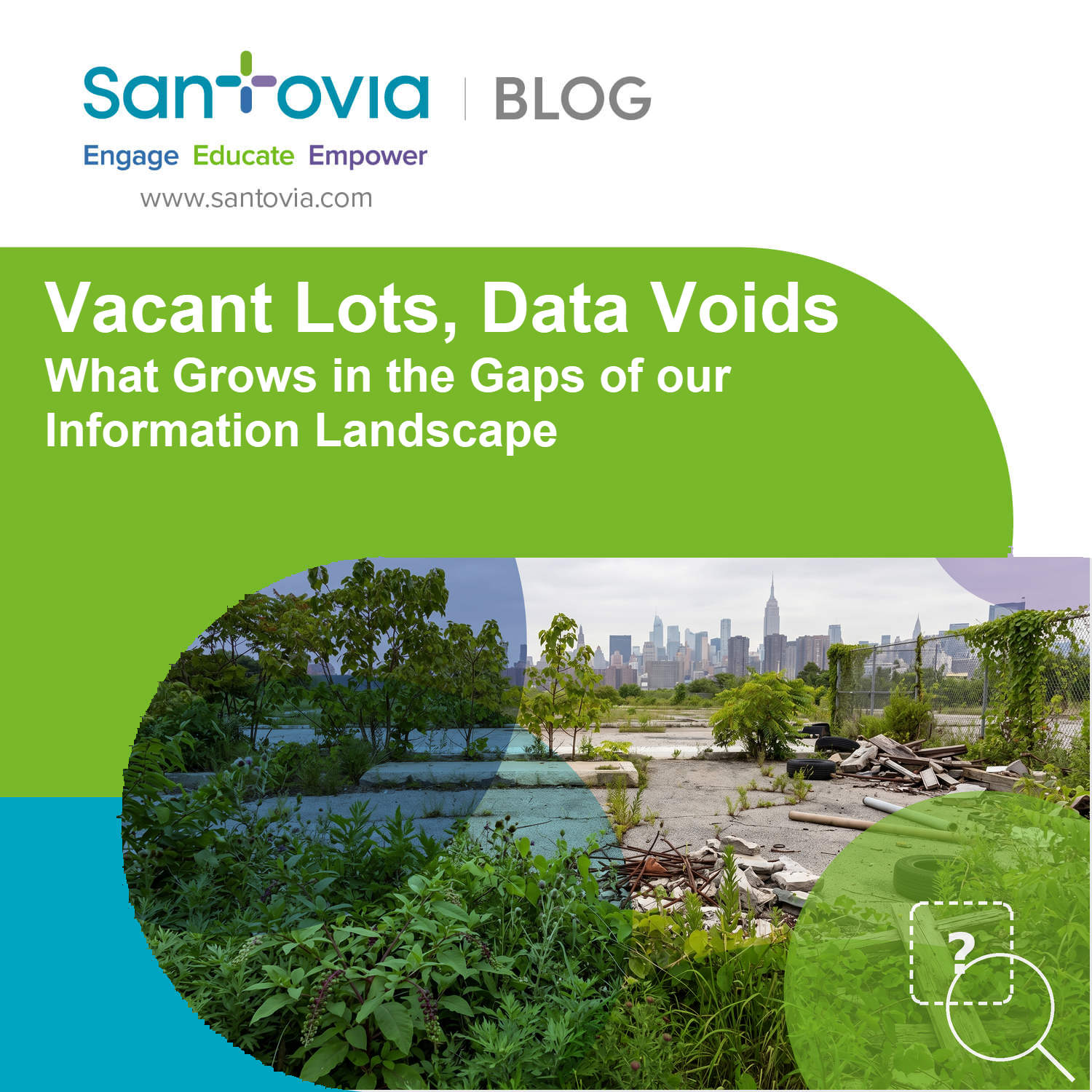
I’ve always been drawn to the empty lots that dot a cityscape. I’m not talking about the massive holes you find in downtowns – craters of half-funded and half-poured foundations, with rebar spikes pointed towards the sky. The spaces that fascinate me are less dramatic; small parcels that slip between apartments or homes, overgrown plots that make spaces in the skyline. They are invisible at first – absence is not always conspicuous – but they sit all over our cities, waiting to be noticed.
These vacant lots always have a story to tell; something was there before, but few clues remain to say what. While I try to fill these spaces with my imagination, in reality they become collection sites for all the refuse of a city. Rotting fences and rusting chain-link do little to stop flying plastic bags, flyers, wrappers, you name it. When you don’t plant anything in a field, weeds grow.
In the past decade we have become familiar with the power of targeted misinformation, rabbit holes, bots and dark algorithms. Something that’s ironically avoided the spotlight of mainstream terminology is the data void. This describes gaps in the online landscape where there’s no high-quality information about a subject; sometimes the topic is too new, sometimes too old, too niche, or too offensive for mainstream sources to make content about. In these gaps, like the empty city lots, there is opportunity for other things – misinformation – to pop up.
When it comes to medicine, the stakes of informational voids are very real. Health misinformation has physical consequences, and the mismatch between the technical, jargony elements of medicine, and the casual, vernacular quality of the internet creates a space for data voids. If you look up “cystic fibrosis symptoms,” you are likely to get a host of high-quality resources by trusted sources. If you look up “skin too salty,” what comes up is very different. And if you type that same prompt into ChatGPT, the results are not only disparate, but the source of the information is completely opaque. It’s not as if there is a shortage of trustworthy information on cystic fibrosis, or nearly any medical topic, but if that information isn’t accessible or tailored to the person seeking it, it might as well sit in a data void.
On platforms like YouTube or TikTok, the problem is even worse than with search engines. These websites only contain what people upload to them, rather than all the public information on the internet. Making the total pool of information smaller increases the chances that there will be data voids, where anything can gain a foothold. In addition, these websites are designed to keep people on them; their algorithms will show users content they are most likely to engage with, rather than what they are looking for. Factual information rarely produces an emotional response, but misinformation does.
Our health is inherently personal. Our medical system as it is today can often feel entirely impersonal. If a patient feels unseen by their doctor, or betrayed by the system, they will turn elsewhere for their health information. When you feel like you know and like somebody, you trust them. That is why you are more likely to buy something when an influencer sells it to you – a good influencer makes you feel like you know them. For some, their doctor feels like a stranger, while a young mother making childcare videos on TikTok may feel like a trusted confidante. Increasingly, care providers are stretched thin, less able to spend quality time with their patients, who are stuck in waiting rooms or separated from their providers by Zoom screens. It can be challenging to build a relationship in this context.
Health influencers, grifters, AI chatbots, and the genuinely misled have stepped into this social and informational void. They offer anecdotes people can connect to, make them feel seen and heard – their credentials are irrelevant. But a story that resonates is not the same as a story that is true: these anecdotes are on occasion untethered from evidence, sometimes flatly untrue, and in some cases delivered by people with a financial stake in what they are promoting. And as more and more people treat their relationship with AI engines and chatbots as social, I fear this problem will only grow.
Data voids defy a simple fix – there are many ways informational gaps can be made, but few ways to solve them. It’s difficult to even detect these holes in the first place; it’s hard to look for an absence. How do you find a void when you don’t even know something should be there in the first place? Instead of trying to find and fill these holes, it would be more fruitful to eliminate the drive to seek them out in the first place. A Snickers is (a little) less alluring when you’ve just had a good meal.
We need to not only make high quality medical information available and accessible in all communities, but also create the conditions where care providers can get to know their patients and build a lasting relationship with them. Doctors have the advantage of being real, physical beings; we can’t underestimate the power of physical touch or the comfort of being cared for by someone in your own neighborhood.
The obverse of the empty lot is the guerrilla garden; places where communities have come together to plant food, flowers, and create green space in the abandoned and neglected cracks of cities. The rubble-filled yards that once created distance between neighbors grow into spaces that bring them closer. You no longer imagine what could be built there.
Care is at its best when it grows out of a greater sense of community. Misinformation and the machinery of the healthcare industry can drive a wedge between regular people and those trying to care for them. But our impulse to trust and help each other is stronger than our suspicions. All we have to do is pull a few weeds.
Written by Seth Husney
Footnote
At Santovia, this is the work we’ve committed ourselves to. We partner with providers and healthcare facilities to put trusted, evidence-based health information directly into patients’ hands – clear, accessible, and delivered by the people who actually know them. Because the best answer to a data void isn’t just better content; it’s a stronger relationship between patients and their own care community. Think of it as planting the garden before the weeds move in.
1. The term “data void” was coined in May 2018 by Microsoft Bing’s Michael Golebiewski and danah boyd, founder of the research institute Data & Society, in a report describing how gaps in search results get exploited by bad-faith actors.